Decimal to Binary Converter
What is a Decimal Number?
A decimal and binary number and converter needs to know the decimal number which is a way of representing numbers using the Base-10 system, which is the standard system we use in everyday life. The term “decimal” comes from the Latin word decimus, meaning “tenth.” In this system, we use ten digits: 0, 1, 2, 3, 4, 5, 6, 7, 8, and 9. When we go beyond 9, we move into the next “place value.”
🔢 Decimal to Binary Converter
0Why Do We Use Decimal?
The decimal system is the global standard for several reasons:
Counting: Humans likely started using Base-10 because we have ten fingers.
Simplicity: It makes addition, subtraction, and multiplication much easier compared to systems like Roman Numerals.
Money: Most currencies are decimalized (e.g., 100 cents = 1 dollar).
The Metric System: Meters, liters, and grams are all based on powers of 10.
Decimals vs. Other Systems
While we use decimals for daily life, other systems are used for specific purposes:
Binary (Base-2): Used by computers (only 0 and 1).
Hexadecimal (Base-16): Used in computer coding and color codes.
Sexagesimal (Base-60): Used for measuring time (60 seconds, 60 minutes) and angles
What Is A Binary Number?
A binary number is a number expressed in the Base-2 numeral system. Unlike our daily decimal system (Base-10), which uses ten digits (0–9), binary uses only two digits: 0 and 1. Each digit in a binary number is called a bit (short for Binary digiT).Why do we use Binary?
Binary is the “language” of computers. Electronic circuits are made of billions of tiny transistors that act as switches.
1 represents an “ON” state (electricity is flowing).
0 represents an “OFF” state (no electricity).
By combining these on/off states in long sequences, computers can represent complex data like text, images, videos, and games.
How Binary Works (Place Value)
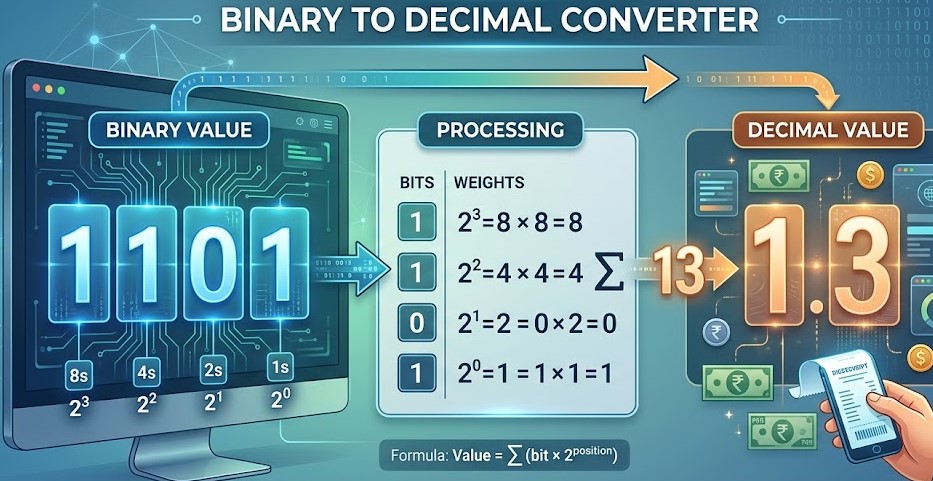
In the decimal system, place values increase by powers of 10 ($1, 10, 100, 1000$). In binary, place values increase by powers of 2, doubling as you move from right to left.
Binary Units of Measurement
Because binary is used in computing, we measure digital storage based on the number of bits:
Bit: A single 0 or 1.
Byte: A group of 8 bits. One byte can represent a single character (like the letter “A”).
Kilobyte (KB): 1,024 bytes ($2^{10}$).
Megabyte (MB): 1,024 kilobytes.
Why we need to convert a decimal number to binary number?
The simplest reason we need to convert decimal to binary is that humans and computers speak different languages. While our brains are wired for the decimal system (Base-10), computer hardware can only understand binary (Base-2).
Why we need to convert the binary number to a decimal number?
Just as we convert dacimal to binary to “talk” to a computer, we convert binary back to decimal so the computer can “talk” back to us in a way we understand. Think of it as a translator who turns a computer’s “machine language” into “human language.”